Last updated: October 22, 2026
Quick answer: a fuse box vs circuit breaker panel comes down to 1 key difference. A fuse box uses replaceable fuses, while a circuit breaker panel uses resettable breakers. In most homes, the circuit breaker panel is the modern standard.
A fuse box vs circuit breaker panel comparison starts with safety, but it also affects convenience, capacity, and upgrades. If you are trying to identify what is on your wall and decide what it means, the short answer is this: a fuse box is older, uses replaceable fuses, and usually signals a smaller electrical system; a circuit breaker panel uses resettable breakers and is the modern standard in most homes.
I write about residential electrical systems and the codes and terms that govern them, so I’ll keep this practical: what you have, what it means, what is safer, and when the fuse box vs circuit breaker panel choice matters.
Key takeaways
- A fuse box protects circuits with one-time fuses that must be replaced after they blow.
- A circuit breaker panel protects circuits with switches that trip and can be reset.
- Breaker panels are usually easier to live with and more common in homes built after the mid-20th century.
- Fuse boxes are not automatically dangerous, but they often come with older wiring, lower capacity, or no room for added loads.
- If you’re planning major appliances, EV charging, or a renovation, the panel type matters because it affects capacity and upgrade options.
- For code and safety context, the National Electrical Code and the Consumer Product Safety Commission are the right reference points, not guesswork.
What a fuse box does that a breaker panel does differently
A fuse box vs circuit breaker panel comparison starts with how each one interrupts power. A fuse box protects the home by sacrificing the fuse; a breaker panel protects the home by tripping a switch. That is the core difference, and it changes the day-to-day experience.
A fuse contains a metal element that melts when current exceeds its rating. Once that happens, the circuit opens and the fuse is dead. You replace it with another fuse of the correct type and amperage.
A circuit breaker is a reusable switch. When it senses overload or a short, it trips to the off position. After the fault is fixed, the breaker can usually be reset. That makes breaker panels more convenient, but not magically immune to problems. A breaker that trips repeatedly is telling you something is wrong on that circuit.
This is also why people confuse the two. Both devices stop overheated wiring from continuing to carry excessive current. Both are safety devices. The difference is that one is single-use and one is resettable.
For code context, the National Electrical Code governs how overcurrent protection is used in U.S. installations, and the U.S. Consumer Product Safety Commission has long warned homeowners about the hazards of overfusing and improvised repairs. If you want the technical baseline, those are better references than forum guesses.
Fuse box vs circuit breaker panel at a glance
A breaker panel wins for most homeowners because it is easier to maintain, easier to expand, and better matched to modern electrical loads. A fuse box can still do the job if it is properly maintained, but it is the less convenient system and the one more likely to limit you.
| Criteria | Fuse box | Circuit breaker panel | Winner for this condition |
|---|---|---|---|
| How it protects a circuit | Fuse melts once | Breaker trips and can be reset | Breaker panel for convenience |
| What happens after a fault | Fuse must be replaced | Breaker can usually be reset | Breaker panel |
| Day-to-day maintenance | Needs spare fuses on hand | Usually no consumables | Breaker panel |
| Capacity for modern loads | Often limited in older homes | Commonly built for larger service needs | Breaker panel for appliances and additions |
| Room for more circuits | Often tight or full | Usually more flexible | Breaker panel for remodels |
| Risk of user error | Higher if wrong fuse is installed | Lower, though misdiagnosis is still possible | Breaker panel |
| Age and availability of parts | Older hardware, fewer parts in common stock | Current standard hardware | Breaker panel |
| Service convenience | More nuisance when a fuse blows | Less disruption after a trip | Breaker panel |
| Visual clue to identify | Screwed-in or cartridge fuses | Toggle switches labeled by circuit | Depends on what you need to identify |
The table does not mean a fuse box is automatically unsafe. It means the breaker panel is the better fit for most present-day households because it handles inconvenience and expansion better. If your question is “which should I want in 2026?”, the answer is usually the breaker panel.
Why a fuse box can still be fine

A fuse box can still be acceptable when the home’s electrical demand is modest and the system has been maintained correctly. That is the part generic articles often skip. Not every fuse box is a disaster waiting to happen.
The strength of a fuse box is that its protection method is direct and simple. A correctly sized fuse opens the circuit when the load exceeds what the wiring can safely carry. There are no moving contacts to reset and no ambiguity about whether a fuse has blown; the element is either intact or it is not.
The weakness is practical, not theoretical. When a fuse blows, you have to replace it. If the home still uses older plug fuses, that means keeping the right replacements around and knowing the difference between the correct fuse size and an unsafe substitute. If someone installs a higher-rated fuse than the wiring can handle, the fuse may stop doing its job.
That is where old fuse boxes become a problem: not because every fuse box is inherently bad, but because they are more likely to be paired with other outdated conditions. Two-prong outlets, ungrounded circuits, knob-and-tube remnants, or an undersized service can all show up in the same house. A fuse box is then a marker for a broader system that may need attention.
A fuse box fits best in a home with light electrical demand, careful maintenance, and no immediate plans for more load. It is not the first choice for someone adding a heat pump, a workshop, a hot tub, or an EV charger. For those uses, the panel type is only part of the story; the service size matters too, which is why the broader electrical panel upgrade question exists at all.
Why a circuit breaker panel is the better fit for most homes
A circuit breaker panel wins for most homeowners because it reduces friction every time a circuit overloads and because it better matches modern household loads. The convenience is obvious, but the real advantage is capacity and flexibility.
Breaker panels are the norm in current residential construction because they are easier to label, easier to reset, and easier to expand when a circuit needs to be added. That matters when a kitchen gets remodeled, a laundry room gets a new appliance, or a garage gets equipment that pulls more current than the house used to see.
The safety advantage is mostly indirect. A breaker panel does not make a home “safe” by itself, but it reduces the temptation to bypass a protection device. People are less likely to jam in the wrong replacement when the fix is to reset a breaker. The system also makes troubleshooting cleaner: if a breaker trips, that is a clear sign the circuit needs attention.
The drawback is that breaker panels can lull people into thinking any trip is a nuisance rather than a warning. A breaker that keeps tripping is not something to ignore. It can point to an overloaded circuit, a failing appliance, or a wiring fault that needs professional diagnosis.
This is why I recommend a breaker panel for most homeowners with current-day electrical needs and a fuse box only when the existing system is still adequate and the household load is modest. If the home is being remodeled or expanded, the breaker panel is the stronger base.
Safety differences that actually matter
A breaker panel is safer in the ways most homeowners are likely to encounter, but the margin is not the same as “safe” versus “unsafe.” The real safety issue is whether the protective device matches the wire and whether someone defeats it.
The important differences are these:
- A fuse box invites replacement, and replacement can go wrong if the wrong fuse rating is used.
- A breaker panel invites resetting, and resetting can go wrong if a repeated trip is ignored.
- Fuse boxes are more often found in older homes, where wiring age and previous modifications can add risk beyond the panel itself.
- Breaker panels usually align better with modern grounding, labeling, and circuit planning, though a modern-looking panel can still hide bad wiring.
One common mistake is assuming a fuse box is dangerous simply because it is old. Age alone is not the issue. An old fuse box with properly sized fuses and sound wiring is one thing; an old fuse box with multiple layers of improvised fixes is another.
Another mistake is assuming every breaker panel is a modern, code-perfect system. A breaker panel can still have double-tapped breakers, missing breakers, overcrowded circuits, or a panel that has no capacity left. The panel face tells part of the story, not all of it.
For a homeowner, the key safety question is not “Which box is better in the abstract?” It is “Does the system still match the home’s electrical demand, and is it maintained correctly?” That is where the panel type matters most.
How to tell what you have and what it means
You can usually identify the system in under a minute, and the shape of the hardware tells you a lot about maintenance.
A fuse box typically has screw-in fuses or cartridge fuses behind a metal door. You may see round, threaded fuses like the older Edison-style type, or pull-out blocks in some installations. If you need to remove a fuse to inspect it, treat the panel as energized unless a qualified person has isolated it properly and has advised you it is safe to proceed.
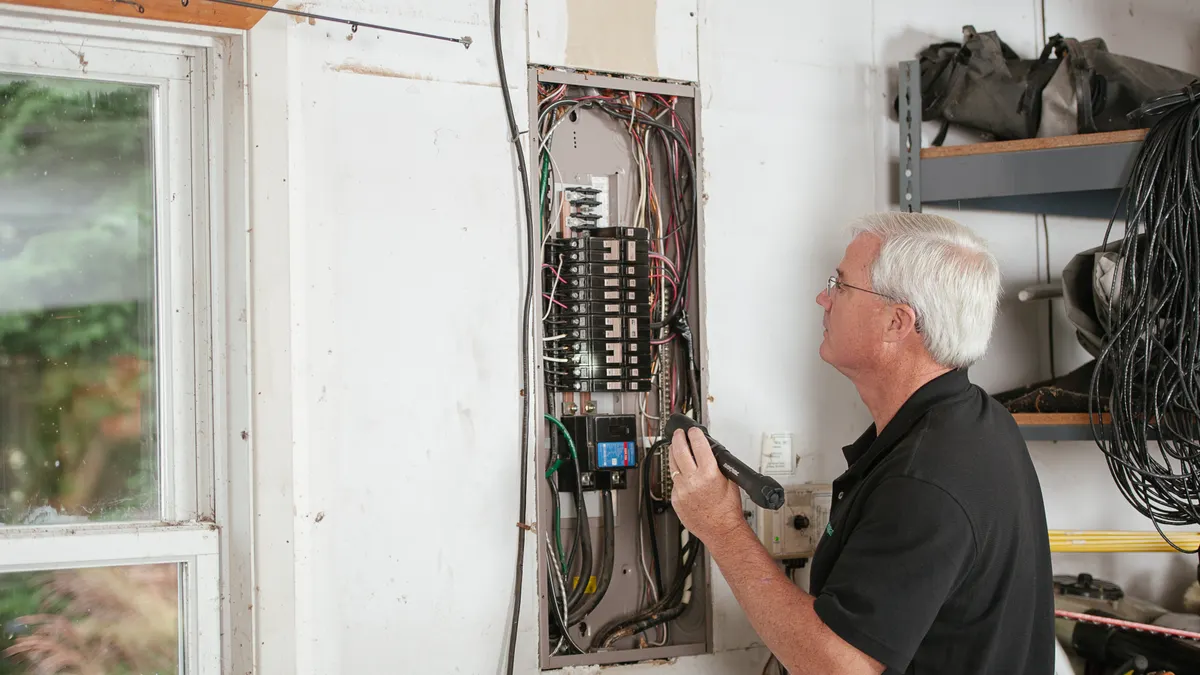
A circuit breaker panel has rows of toggle switches labeled by circuit. Each breaker usually has an on/off position and may show a tripped position in the middle. Some panels have a main disconnect and separate branch breakers.
What it means for you:
- Fuse box: Expect slower maintenance, less convenience, and a higher chance that the home’s electrical system is dated.
- Breaker panel: Expect easier resets, more common replacement parts, and a better fit for normal modern household use.
If the labels are missing or the cover looks damaged, that is not a trivia problem. It is a service problem. Mislabeling makes troubleshooting harder and increases the chance of turning off the wrong circuit. If the panel is crowded, warm, rusted, or frequently overloaded, it deserves attention from a licensed electrician.
The honest verdict: which one should you want?
Choose a circuit breaker panel if your home uses ordinary modern appliances, you want easier maintenance, or you plan to add electrical load. Choose a fuse box only if the existing system is still adequate, the home’s demand is modest, and you are not planning upgrades that will stress the service. Neither if the panel is damaged, unlabeled, overloaded, or obviously part of a larger outdated electrical setup that needs professional assessment.
That is the straight answer. For most homeowners, the breaker panel is the right choice because it is easier to live with and better aligned with current residential electrical needs. The fuse box is not automatically a problem, but it is the less flexible option and the one more likely to limit future use.
If your house still has a fuse box, the next question is usually not “Can I keep it?” but “Does the whole electrical system still fit the way I use the house?” That is the real decision point.
When the answer flips
A fuse box can beat a breaker panel in a few narrow cases, and those cases matter.
First, if you have a small, lightly loaded property where the electrical demand has not changed in years, a properly maintained fuse box can be adequate. A cabin, rental cottage, or older home with limited usage can sometimes run safely on an old system, provided the wiring is in good condition and no one is improvising with oversized fuses.
Second, if the breaker panel you are comparing against is a poor-quality, crowded, or poorly maintained panel, the “modern” label does not help it. A neglected breaker panel with no spare spaces and obvious service issues is not a better answer just because it has switches.
Third, if a home is already scheduled for a broader electrical project, the panel choice may be part of a larger plan rather than a simple either-or. That is where service size, circuit count, grounding, and code compliance become the real constraints.
Fourth, if the issue is just identifying what you have, not replacing it, the panel type is less important than the condition of the equipment. A clean, well-labeled fuse box still tells you one thing: your maintenance approach has to be more deliberate.
Can a fuse box be upgraded?
Yes, but the right answer is usually a broader electrical service upgrade rather than a simple swap. A fuse box can be replaced with a breaker panel, but the rest of the system has to be evaluated at the same time.
That is because the panel is only one part of the electrical chain. The service entrance, grounding, bonding, meter base, feeder conductors, and branch circuits all affect whether an upgrade is straightforward or more involved. A homeowner should not assume that changing the box alone solves capacity or safety issues.
If you are considering an upgrade, the practical reason is usually one of three things: more circuits, more load, or more confidence in the system. That decision belongs in a broader conversation about the home’s electrical service, which is why the separate guide on electrical panel upgrade is the right next stop.
FAQ
Is a fuse box outdated?
Yes, in most homes a fuse box is considered outdated. That does not mean it is automatically unsafe, but it does mean it is less convenient and less flexible than a breaker panel. Homes with modern appliance loads usually do better with breaker-based protection and a service sized for current use.
Which is safer, a fuse box or breaker panel?
A breaker panel is generally safer for most homeowners because it is harder to defeat by accident and easier to reset after a trip. A fuse box can still be safe if it is correctly sized and maintained, but it is easier for someone to install the wrong fuse. If the system is old or damaged, have a licensed electrician assess it.
Can a fuse box be upgraded?
Yes, a fuse box can usually be replaced with a circuit breaker panel during a service upgrade.
Drafted with AI; not yet reviewed by a person.